
Scottsdale, AZ · Licensed Plumber · Same-Day Service
Pressure Reducing Valve Replacement in Scottsdale
Water pressure over 80 psi quietly wears out water heaters, supply lines, toilets and faucets. We test your pressure, replace worn pressure reducing valves (PRVs), and set your home to a safe 55–65 psi. Flat-rate written quotes from a licensed Scottsdale plumber, ROC #350819.
- 100+ Five Star Reviews
- Licensed · ROC #350819
- 7+ Years Plumbing in Arizona
What's included
Done right the first time
- Free pressure test with a calibrated gauge on every visit
- Watts, Wilkins/Zurn and Cash Acme PRV replacement
- PRV adjustment when the valve is still healthy
- New full-port shut-off valve and unions where needed
- Expansion tank check and install for closed systems
- Fixes banging pipes, running toilets and dripping relief valves
- Set to 55–65 psi — well under Arizona's 80 psi limit
- Same-day service across Scottsdale & the Valley
Our Process
Simple, honest, transparent
-
1
Test the Pressure
We read static pressure at a hose bib and watch it overnight-style for creep, so we know if the valve is failing or just set wrong.
-
2
Replace the Valve
Water off at the main, old PRV cut out, new valve installed with unions and a shut-off so the next service is quick and clean.
-
3
Set & Verify
Pressure set to 55–65 psi, every fixture and the water heater checked, expansion tank confirmed, and the area left clean.
From the blog
Featured reads on this service
FAQs
Common questions
How much does pressure reducing valve replacement cost in Scottsdale?
Most Scottsdale PRV replacements run $450–$850 installed in 2026 for a standard 3/4" or 1" Watts or Wilkins valve, including a pressure test and setting the new valve. Hard-to-reach valves, corroded unions, or adding new shut-off valves and a pressure gauge can bring it to $900–$1,300. You get a flat written quote before any work starts.
What water pressure should my Scottsdale home have?
Arizona plumbing code limits household pressure to 80 psi. We set most homes between 55 and 65 psi — strong showers without stressing water heaters, supply lines, toilet fill valves and appliance hoses. Some Scottsdale neighborhoods see city pressure well above 100 psi, which is why a working PRV matters.
What are the signs of a failing pressure reducing valve?
Banging or hammering pipes, a water heater relief valve that drips, toilets that run or refill on their own, faucets that spit, frequent failed supply lines, or pressure that swings between strong and weak. A gauge on a hose bib reading over 80 psi confirms it.
How long does a PRV last in Arizona?
Most pressure reducing valves last 7–12 years. Scottsdale's hard water (roughly 12–18 grains) builds scale on the internal seat and spring, so valves here often fail toward the short end of that range.
Where is the pressure reducing valve on my house?
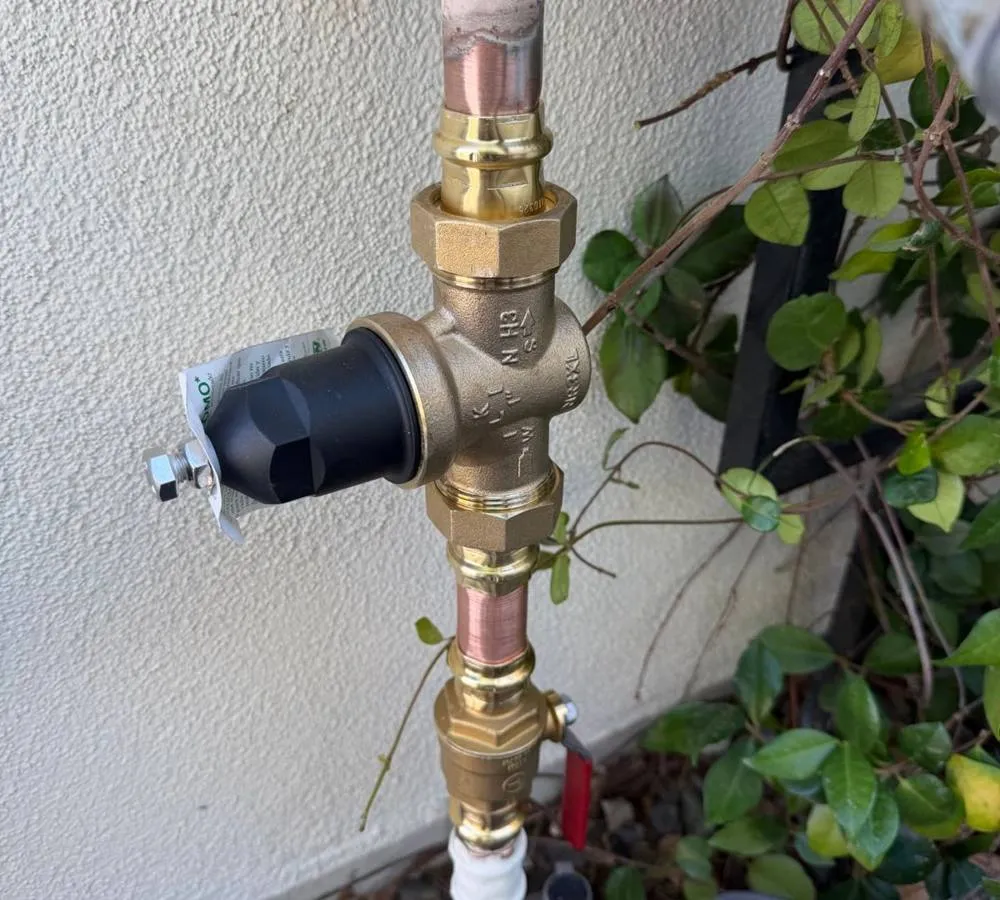
In most Scottsdale and Phoenix homes the PRV sits on the main line where it comes out of the ground, usually near the front hose bib or the main shut-off — a bell-shaped brass valve with an adjusting bolt on top. Some older homes have it in the garage or no PRV at all.
Do I need an expansion tank with a new PRV?
Often, yes. A PRV creates a closed system, so water heated in your tank has nowhere to expand. That pressure spike can make the relief valve drip and shorten the heater's life. We check for a working, properly charged expansion tank on every PRV job.
Can you adjust my PRV instead of replacing it?
If the valve is fairly new and just set too high, we'll adjust it and confirm with a gauge. If it won't hold a steady setting, creeps up overnight, or is leaking, replacement is the reliable fix.
Service Areas